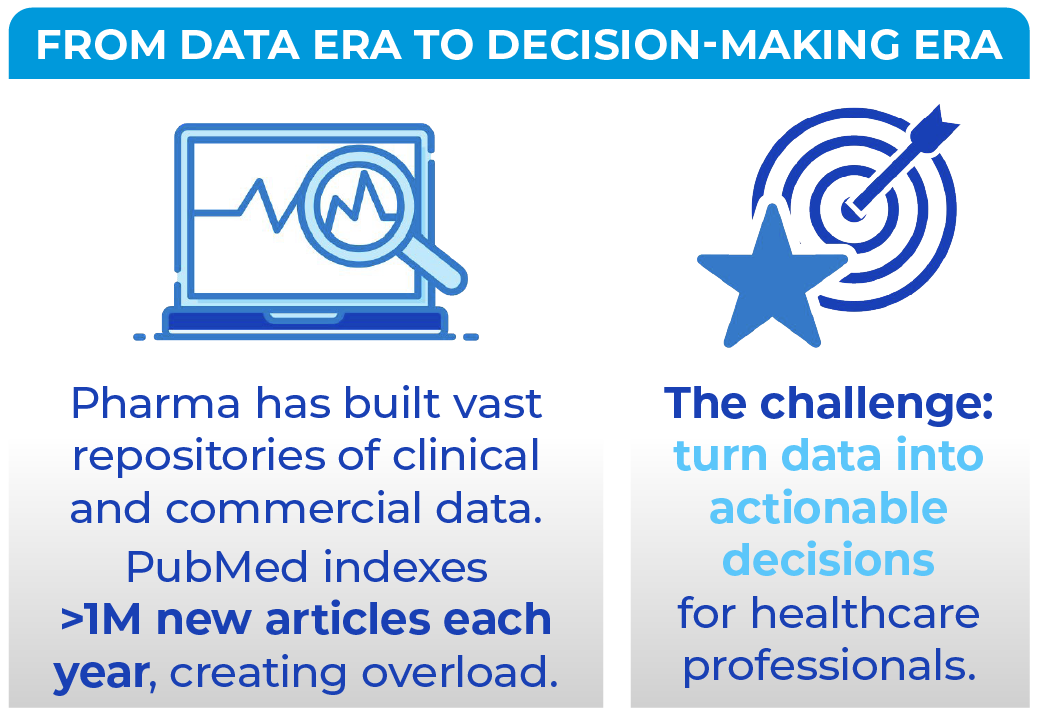
For more than two decades, the pharmaceutical industry has invested heavily in collecting, organizing, and analyzing scientific and commercial data. From clinical trial registries to real-world evidence platforms, Pharma has built vast repositories of information.1
But scale is no longer the differentiator.
As healthcare grows more complex, regulatory scrutiny intensifies, and therapeutic innovation accelerates, the competitive advantage is shifting. The question is no longer who has more data. It is who can turn data into faster, clearer, and more confident decisions.
That shift marks the beginning of a new era: the Decision-Making Era.
In this environment, scientific communication becomes far more than a support function. It becomes a strategic capability — one that transforms evidence into relevance, relevance into action, and action into better decisions for healthcare professionals (HCPs), patients, and brands.1
Data Scale No Longer Creates Differentiation
Biomedical information is expanding at extraordinary speed. PubMed alone indexes more than one million new articles every year.2 That volume reflects scientific progress, but it also creates a new problem: overload.
Healthcare professionals do not need more information. They need sharper prioritization, stronger context, and faster clarity. They need help identifying what matters, what changes practice, and what deserves trust.
The same is true inside pharma organizations. Commercial and medical teams are under growing pressure not merely to collect evidence, but to interpret it quickly enough to shape brand strategy, message refinement, channel orchestration, and customer engagement in real time.1
The Strategic Shift: From Data Management to Decision Execution
Artificial intelligence (AI)-enabled analytics is compressing the interval between feedback and action from weeks or months to hours. At the same time, AI-driven personalization is shifting pharma communication from brand-centric broadcasting to customer-centric relevance,3–5 while omnichannel engagement continues to evolve, through integrated data and feedback across touchpoints.3
That changes the operating model for Pharma marketing. Teams can identify message friction earlier, detect shifts in HCP sentiment faster, and optimize campaigns while impact is still recoverable — not after the opportunity has passed.1
The traditional model rewarded companies for building dashboards, reports, and repositories. The new model rewards companies for building systems that improve judgment.
The real question is no longer:
How much data do we have?
It is now:
How fast can we turn evidence into action?
Foundations of the Decision-Making Era
Big Data helped create the conditions for this shift. Initially described by the classic “3 Vs” — Volume, Variety, and Velocity — the concept has since expanded to seven dimensions:6
- Volume
- Variety
- Velocity
- Veracity
- Visualization
- Variability
- Value
These dimensions make one point unmistakably clear: data only creates advantage when it is reliable, interpretable, and actionable.7,8
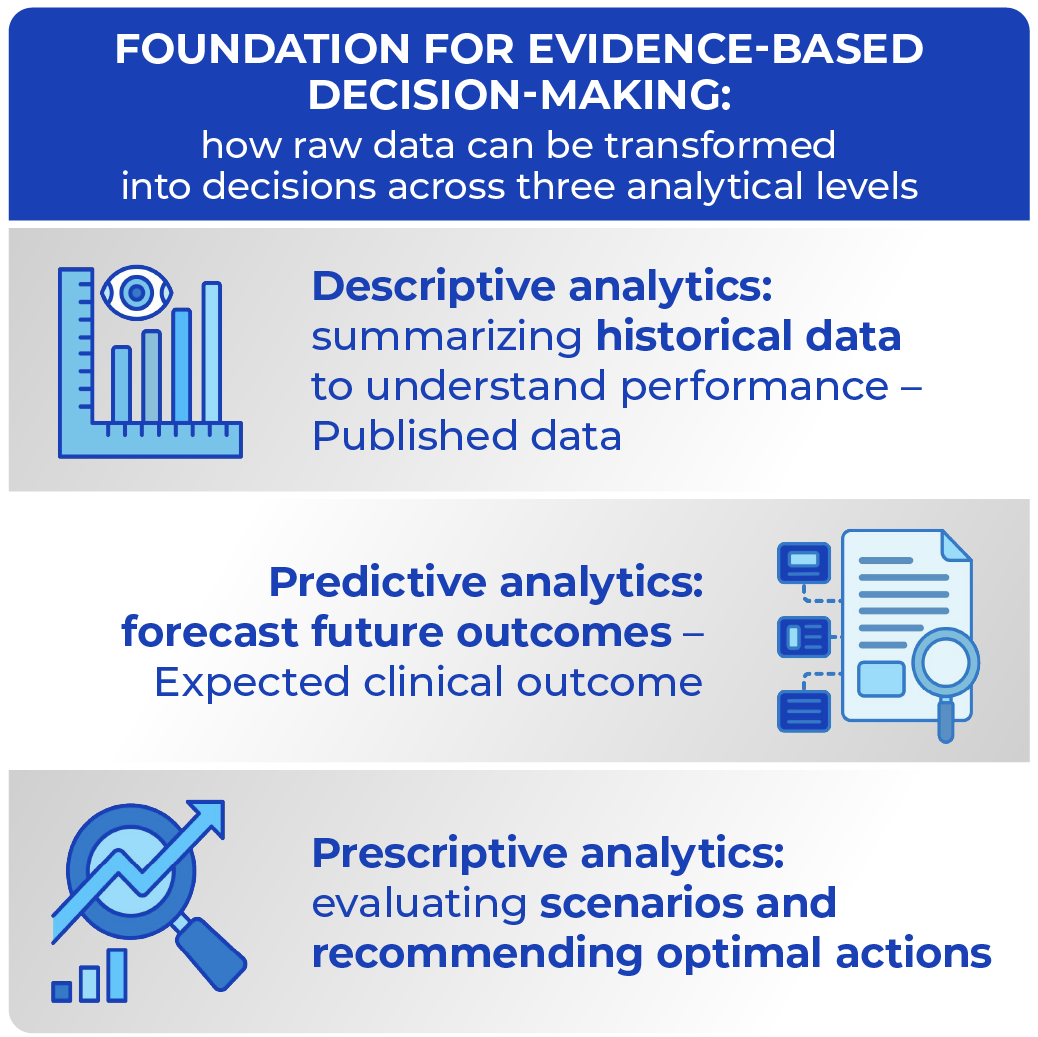
That is where business analytics becomes critical. At a strategic level, data supports decision-making through three layers:9
- Descriptive analytics: understanding what happened (summarizing historical data)
- Predictive analytics: estimating what is likely to happen next (using statistical models and machine learning)
- Prescriptive analytics: recommending what should be done (evaluating scenarios)
For Pharma marketers, this progression is highly relevant. It means the commercial value of evidence lies not in its existence, but in its ability to support action — whether that action is a prescribing decision, a brand strategy shift, or a better customer experience.
Scientific Communication Is Becoming a Commercial Differentiator
Scientific communication sits at the center of this transformation.
As knowledge dissemination accelerates across channels such as social media, preprints, content hubs, modular content ecosystems, and omnichannel journeys, the market is flooded with information.10,11 But speed without interpretation does not create value. In many cases, it creates noise.
That is why scientific communication now has a more demanding role: not merely to disseminate evidence, but to translate it into usable decision frameworks.
For Pharma, that means scientific communication must now do three things exceptionally well:
- distill complexity without diluting rigor;1,9
- connect the right message to the right moment in the HCP journey;3,12
- strengthen trust while using AI and personalization at scale.8,13
This is no longer a matter of editorial quality alone. It is a matter of commercial performance.
The New Standard Is Not Visibility. It Is Usability.
For years, much of pharma marketing optimization focused on reach, frequency, and channel presence. Those still matter. But they are no longer sufficient.
In the Decision-Making Era, the stronger question is whether your communication is usable at the moment of choice.
- Can an HCP quickly understand the implication of your data?
- Can a medical or commercial team identify which message is gaining traction and which is not?
- Can the brand move from evidence to execution faster than competitors?
That is why the next generation of high-performing Pharma content will look less like static promotion and more like decision infrastructure: comparative data views, modular omnichannel assets, visual summaries, clinical-context tools, and personalized scientific narratives that make action easier.1,3,12
The future does not belong to companies that communicate more. It belongs to companies that communicate with greater precision, better timing, and higher decision utility.1,4,8,12–15
Why Promotion Still Matters — Perhaps More Than Ever
A common misconception is that as the industry becomes more data-driven and decision-focused, promotion becomes less important. In reality, the opposite may be true.
Decision-making still begins with awareness. A physician cannot consider, evaluate, or adopt a therapy that is absent from memory. In Pharma Marketing, that makes promotion strategically indispensable.2
Several principles explain why:
- Awareness drives consideration: If a product is not known, it is unlikely to be prescribed. Awareness is the gateway to trial and adoption.2
- Memory shapes choice: Repetition and reinforcement improve recall, and recall is a strong predictor of marketing effectiveness. Storytelling and cross-channel exposure help brands remain memorable.12
- Availability influences decisions: Cognitive science shows that people tend to choose what comes most easily to mind. In prescribing contexts, promotion helps keep a brand within the physician’s “evoked set.”2
- Familiarity supports trust: Known brands often feel less risky. Familiarity can strengthen confidence in both the information and the product behind it.2
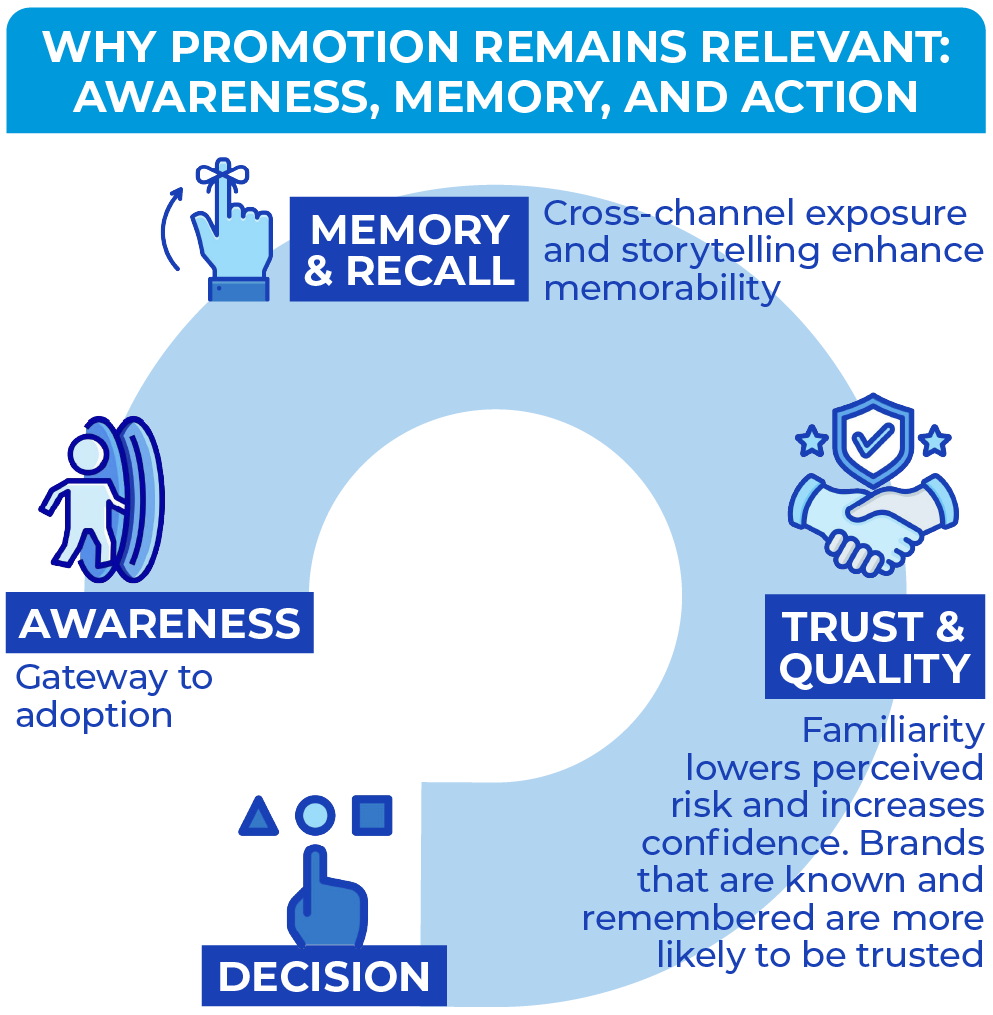
Promotion therefore remains essential. Its role, however, becomes more sophisticated: ensuring that the right scientific and brand messages are available, memorable, and credible at the moment decisions are made.
The Three Competitive Advantages That Will Matter Most
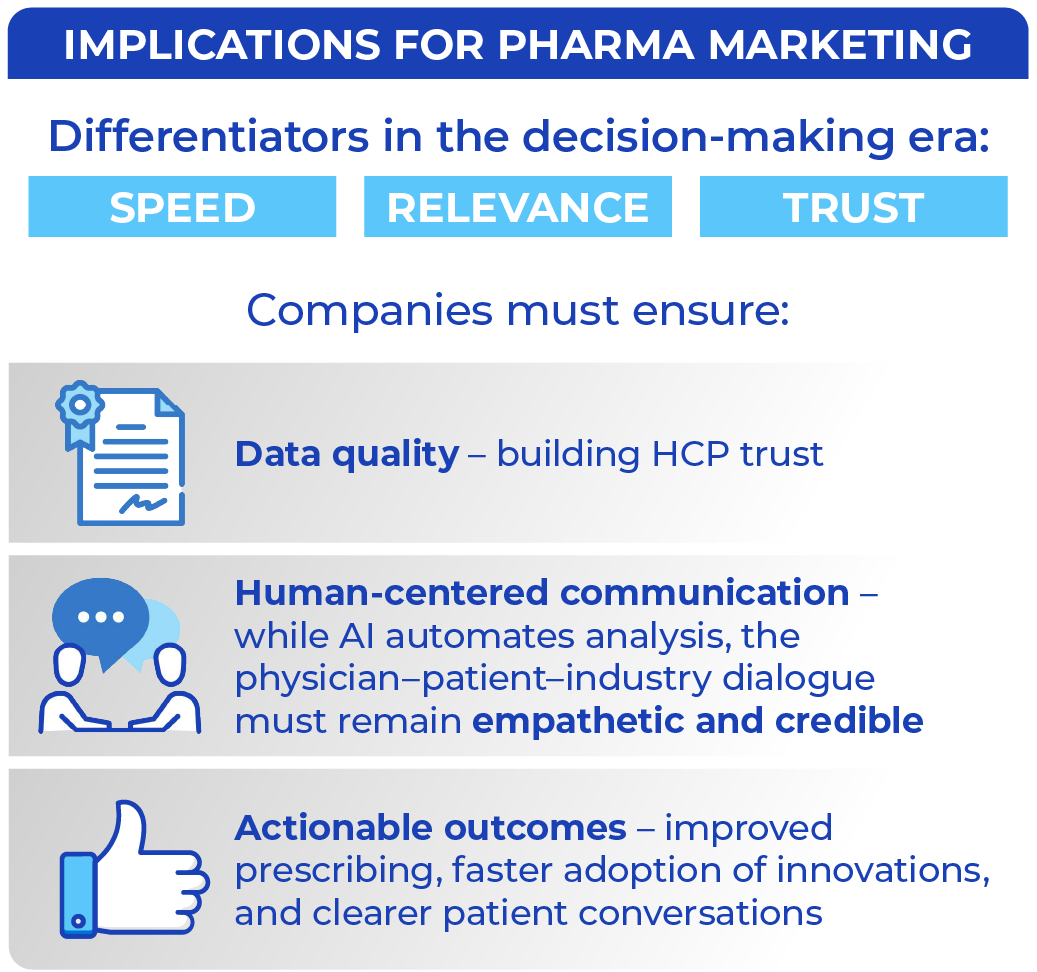
In the Decision-Making Era, competitive advantage will increasingly depend on three factors:
- Speed
Insights that arrive too late have limited value. Commercial and scientific teams need systems that detect changes in HCP perception, message performance, and market dynamics quickly enough to act on them.1,12–14 Teams that learn faster will adapt faster. Teams that adapt faster will outperform.1,12–14
- Relevance
Information must do more than inform. It must help customers decide. That requires translating evidence into formats that are easier to use in practice — such as infographics, comparative data views, clinical pathways, modular content, omnichannel decision-support assets.1,3,12
- Trust
As data ecosystems become more complex and AI becomes more embedded in content creation and engagement, trust becomes a brand asset. Data privacy, transparency, bias control, scientific integrity and human interactions directly affect credibility, adoption, and long-term differentiation.8,16,17
This means Pharma organizations should prioritize:
- Data quality and governance: decisions are only as strong as the evidence behind them.17
- Human-centered communication: even in AI-enhanced environments, credibility still depends on empathy, clarity, and relevance.16,17
- Actionable outcomes: the real measure of communication is whether it improves decisions — better prescribing, faster adoption of innovation, and clearer conversations with patients.1,16,17
Conclusion
The Data Era built the infrastructure; it created scale. The Decision-Making Era will determine who creates value from that scale.
In this new landscape, scientific communication is no longer about distributing information at scale. It is about enabling confident action. The companies that will lead are those that can:
- convert evidence into decisions,
- complexity into clarity, and
- innovation into trust.
That is why scientific communication is becoming one of the most important strategic assets in Pharma Marketing.
The message for Pharma marketers is straightforward: data alone is no longer enough. Decisions are the new currency. And communication is what makes those decisions possible.
How to cite this article: KACHI. The Data Era Is Shifting to the Decision-Making Era: What This Means for Pharma Marketing. São Paulo: KACHI Comunicação Científica, 2026, Mar 18. Available from: https://www.kachi.com.br/en/article-decision-making-era-in-pharma-marketing/
References:
1. IQVIA. The Crucial Role of Real-Time Data Use in Pharma Marketing [Internet] [Internet]. IQVIA Blogs. 2024;Available from: https://www.iqvia.com/blogs/2024/11/the-crucial-role-of-real-time-data-use-in-pharma-marketin
2. Schwartz LM, Woloshin S. Medical Marketing in the United States, 1997-2016. JAMA 2019;321(1):80–96.
3. Pi T, Ruan H, Xie Y, Hypothesis N. Content Management Strategies for Pharmaceutical Companies Navigating Omnichannel Marketing [Internet]. 2024 [cited 2025 Sep 4];Available from: https://www.lek.com/insights/hea/cn/sr/deep-dive-content-management-strategies-pharma
4. Dingre S, Girbane V, Sankhe N, Todakari P, Borawake D, Deshmukh M. Emerging trends in pharmaceutical marketing strategies for allopathic drugs. International Journal of Science and Research Archive 2025;15(3):667–73.
5. Bates A. New business models are the medicine needed to save pharma from the disease of disruption [Internet]. Eularis – Accelerating Business Growth. 2023 [cited 2025 Sep 4];Available from: https://eularis.com/new-business-models-are-the-medicine-needed-to-save-pharma-from-the-disease-of-disruption/
6. Ooi PTB, Yuan NK. Ethical use of Big Data and Artificial Intelligence in Biomedical Research [Internet]. The Bioethics Advisory Committee Singapure. 2025, Feb;Available from: chrome-extension://efaidnbmnnnibpcajpcglclefindmkaj/https://file.go.gov.sg/bac-bdai-report-2025.pdf
7. Floridi L. Big Data and Their Epistemological Challenge. Philosophy & Technology 2012;25(4):435–7.
8. Ooi PTB, Yuan NK. Ethical use of Big Data and Artificial Intelligence in Biomedical Research [Internet]. The Bioethics Advisory Committee Singapure. 2025, Feb;Available from: chrome-extension://efaidnbmnnnibpcajpcglclefindmkaj/https://file.go.gov.sg/bac-bdai-report-2025.pdf
9. Ibeh CV, Asuzu OF, Olorunsogo T, Elufioye OA, Nduubuisi NL, Daraojimba AI. Business analytics and decision science: A review of techniques in strategic business decision making. World Journal of Advanced Research and Reviews 2024;21(2):1761–9.
10. Christie AP, White TB, Martin PA, et al. Reducing publication delay to improve the efficiency and impact of conservation science. PeerJ 2021;9:e12245.
11. Korjonen MH. Clinical trial information: developing an effective model of dissemination and a framework to improve transparency [dissertation] [Internet]. University College London. 2011, Jun;Available from: chrome-extension://efaidnbmnnnibpcajpcglclefindmkaj/https://discovery.ucl.ac.uk/id/eprint/1344051/1/1344051.pdf
12. Mor J, Kaur T, Menkes DB, Peter E, Grundy Q. Pharmaceutical industry promotional activities on social media: a scoping review. J Pharm Health Serv Res 2024;15(4):rmae022.
13. Bromme R, Mede NG, Thomm E, Kremer B, Ziegler R. An anchor in troubled times: Trust in science before and within the COVID-19 pandemic. PLoS One 2022;17(2):e0262823.
14. Orzan G, Zara IA, Purcarea VL. Neuromarketing techniques in pharmaceutical drugs advertising. A discussion and agenda for future research. J Med Life 2012;5(4):428–32.
15. Cardona-Acevedo S, Agudelo-Ceballos E, Arango-Botero D, et al. Applications of Machine Learning (ML) in the context of marketing: a bibliometric approach. F1000Res 2025;14:92.
16. Thorp HH. Trust edges up-slightly. Science 2024;386(6724):831.
17. Yu JH, Lee S, Kim YJ, Kim WY, Lee MJ, Kim Y. Assessing Post-Marketing Requirements for Orphan Drugs: A Cross-Sectional Analysis of FDA and EMA Oversight. Clin Pharmacol Ther 2024;116(6):1560–71.